Air Compressor Motor Hums But Won’t Start: Causes And Fixes
A motor that hums but will not start usually has a weak capacitor, low voltage, or a pressure-related fault.
When an air compressor motor hums but won't start, it is trying to turn but cannot create enough starting force. This guide explains the common causes, safe tests, repair options, and warning signs that call for a qualified electrician or technician.
What the humming sound means
A humming motor is receiving power. However, the motor shaft is not reaching normal speed. Think of it like a car starter that turns slowly but cannot crank the engine.
An air compressor motor hums but won't start because the starting circuit may be weak, the pump may be under too much load, or the motor may be unable to turn freely. The hum often comes from the motor windings drawing current while the rotor remains stuck or slow.
Stop the compressor as soon as you hear the hum. A motor that stays energized without spinning can overheat in seconds or minutes. Its thermal overload may trip, but that safety feature is not meant to protect the motor from repeated stalled starts.
Common clues include:
• A steady hum followed by a breaker trip
• A click from the overload protector
• A motor that starts only after the tank is empty
• A compressor that starts with a light push on the pulley, if designed for safe manual testing
• A hot motor housing or burning electrical smell
• Lights dimming when the compressor tries to start
Safety steps before troubleshooting
Compressed air tanks store energy, and electrical circuits can cause severe injury. Do not remove a motor cover, capacitor cover, or pressure switch cover while the unit is connected to power.
Before testing, follow these steps:
- Turn the compressor off.
- Unplug it or switch off the correct circuit breaker.
- Close the tank outlet valve.
- Drain the air tank to zero pressure if the repair requires pump work.
- Wait several minutes for the motor and capacitor to cool.
- Verify that power is off with a properly rated meter.
- Keep hands, tools, clothing, and hair away from belts and pulleys.
Never touch a capacitor terminal, even after unplugging the compressor. Some capacitors can hold a charge. A qualified person should discharge and test them with the correct equipment.
Do not bypass the pressure switch, thermal overload, or other safety device. If the motor makes a sharp electrical buzz, smells hot, or trips the breaker at once, stop testing. Repeated resets can turn a small fault into a burned motor.
Electrical work should follow the equipment manual and local code. If you are not trained to test live voltage, call a licensed electrician or compressor technician.

Why an air compressor motor hums but won't start
Several faults can produce the same symptom. The most likely cause depends on the compressor type, voltage, age, tank pressure, and what happens after the hum begins.
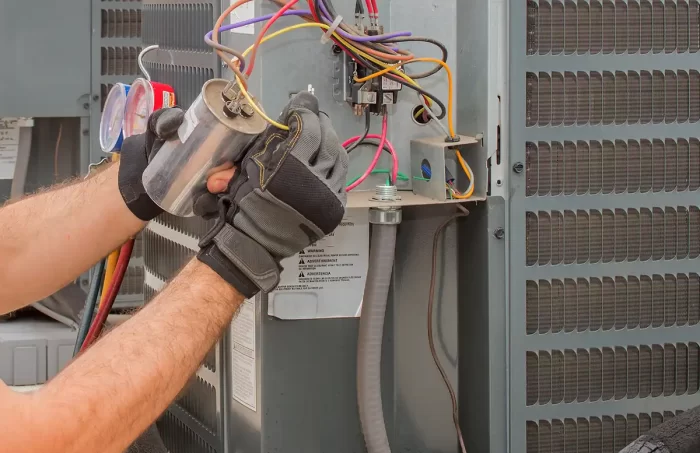
Weak or failed start capacitor
A start capacitor gives the motor extra force for the first turn. If it is weak, swollen, leaking, cracked, or open, the motor may hum without starting.
Some compressors use a start capacitor and a run capacitor. Others use a single capacitor for both jobs. The correct replacement must match the rated microfarads and voltage shown on the original part or in the manual.
A capacitor can look normal and still be faulty. Capacitance testing with a suitable meter gives better evidence than a visual check.
Low voltage or a long extension cord
A motor needs enough voltage to develop starting torque. A long, thin extension cord can create voltage drop. The motor then draws high current but lacks the force needed to start.
This is a common reason an air compressor motor hums but won't start in a garage or workshop. The compressor may work when connected near the panel but fail at the end of a long cord.
Check the following:
• Extension cord length and wire size
• Loose plugs or worn receptacles
• A shared circuit with heaters, saws, or shop vacuums
• The compressor’s rated voltage
• Voltage at the motor terminals during the start attempt
Do not use a larger circuit breaker to hide a voltage problem. The breaker protects the wiring, not just the motor.
Tank pressure is too high
Most compressors have an unloader valve. When the motor stops, this valve releases air trapped between the pump and the check valve. That lets the motor start with little load.
If the unloader fails, the motor may try to start against trapped pressure. The result is often an air compressor motor hums but won't start, especially when the tank already contains air.
You may hear a short hiss when the compressor shuts off. That hiss is usually normal. If there is no release at all, or air leaks continuously, inspect the pressure switch and unloader system.
Faulty tank check valve
The check valve lets air flow into the tank but prevents tank air from flowing back toward the pump. If it leaks or sticks, pressure can remain on the pump outlet.
A leaking check valve may cause:
• A hard start after the compressor shuts off
• Continuous air leaking through the unloader
• A motor that starts easily with an empty tank but not a full tank
• Slow tank filling or frequent cycling
Relieve all tank pressure before removing or cleaning this valve. A check valve problem can look like a motor problem, so testing the air side matters.
Jammed pump or belt
A locked pump, seized bearing, damaged reed valve, or tight belt can stop the motor from turning. With power disconnected, some belt-driven compressors allow you to turn the pump pulley by hand.
The pulley should move smoothly through the pump cycle. It may have resistance, but it should not lock, grind, or feel rough. Direct-drive compressors can be harder to inspect because the motor and pump share one shaft.
Never reach near a belt while power is connected. If the pump is locked, replacing the capacitor will not solve the real problem.
Bad pressure switch or motor switch
The pressure switch controls power to the motor. Burned contacts may pass enough current to create a hum but not enough to start the motor properly. A loose wire or damaged terminal can cause the same result.
Look for discolored terminals, melted insulation, loose screws, or insect damage. Do not rely on a visual check alone. Electrical contacts can fail under load even when they look clean.
Thermal overload or motor winding damage
A thermal overload opens the circuit when the motor becomes too hot. It may reset after cooling, but repeated trips point to an underlying fault.
Damaged windings can produce a hum, high current, heat, and a burning odor. A motor with shorted or open windings often needs professional testing or replacement. Continuing to reset it is rarely a good repair strategy.
A safe troubleshooting process
An air compressor motor hums but won't start most often because of a small number of faults. A step-by-step process helps you avoid replacing good parts.
1. Check the tank pressure
Read the tank gauge before starting the compressor. If the tank is full or partly full, listen for the unloader when the motor stops.
If the compressor starts only after the tank is drained, suspect the unloader, check valve, or pressure switch. This pattern is especially useful because it separates a load problem from a basic power problem.
2. Confirm the power supply
Make sure the plug is fully seated and the breaker has not tripped. Check whether other high-power tools share the circuit.
Use the voltage listed on the nameplate. A 120-volt compressor should not be connected to a circuit with a serious voltage drop. A 240-volt compressor must have the correct two-pole supply and wiring.
If the motor hums and the breaker trips immediately, do not keep trying. That may indicate a locked rotor, shorted winding, bad capacitor, or severe mechanical load.
3. Inspect the capacitor
Disconnect power and follow the manual before touching the capacitor. Look for bulging ends, oil, cracks, melted plastic, or damaged terminals.
Replace a failed capacitor only with the correct type. A higher microfarad rating is not automatically better. The wrong capacitor can damage the motor or create a dangerous starting condition.
4. Test the unloader and check valve
With the compressor off, listen for the short air release. A constant hiss suggests a leaking unloader, while no release may suggest a blocked or failed unloader.
A technician can isolate the check valve and test whether pressure remains in the pump discharge line. This test is safer and more reliable than guessing from sound alone.
5. Inspect the pump and motor shaft
After disconnecting power, check the belt, pulley, and pump for visible damage. Turn the pulley only if the design allows it and the manual supports that inspection.
Grinding, tight spots, oil contamination, or a locked pulley suggests a mechanical repair. Do not force the pulley. A bent crankshaft or seized bearing may cause more damage if you keep turning it.
6. Check motor current and winding condition
A clamp meter can show whether the motor is drawing locked-rotor current. Resistance and insulation tests can help identify winding damage, but these tests require correct procedures and suitable equipment.
A motor that draws excessive current while humming is not safe to operate. Current readings must be compared with the motor nameplate and manufacturer data, since normal values vary by motor size and load.

Common repair solutions
The correct fix depends on the test result. Avoid changing several parts at once because you may lose the chance to identify the original cause.
• Replace a weak capacitor with the exact rated part.
• Repair or replace a failed unloader valve.
• Clean or replace a leaking tank check valve.
• Use the correct extension cord or install a suitable dedicated circuit.
• Tighten or repair loose electrical connections with power off.
• Replace a damaged pressure switch when its contacts fail.
• Repair a seized pump, bearing, belt, or pulley.
• Replace a motor with burned windings or severe bearing damage.
In my experience working around shop compressors, the most common mistake is replacing the motor before checking the unloader. A compressor that starts well from an empty tank but struggles after shutdown often has a pressure-release problem, not a dead motor.
Another mistake is installing a capacitor based only on physical size. Electrical ratings matter more than appearance. Always match the microfarad range, voltage rating, terminal style, and capacitor type.

When the capacitor is not the real problem
A new capacitor may briefly make the compressor start, but that does not prove the capacitor was the root cause. If the pump is tight or the power supply is weak, the replacement may fail again.
Use these clues:
• Starts with an empty tank but not a full tank: inspect the unloader and check valve.
• Hums on every start and gets hot: inspect the capacitor, voltage, and motor.
• Trips the breaker instantly: inspect for a short, locked pump, or winding fault.
• Starts after cooling: inspect overload conditions, bearings, and voltage.
• Runs but struggles to build pressure: inspect valves, rings, leaks, and pump wear.
• Makes grinding sounds: inspect the motor bearings, pump bearings, and belt system.
A compressor motor is designed to reach speed quickly. If it hums for more than a brief moment, switch it off. Letting it stall is like holding a car engine at full throttle with the wheels locked.

Preventing future starting problems
Good maintenance can reduce the chance that an air compressor motor hums but won't start. It cannot prevent every electrical failure, but it can limit heat, moisture, and mechanical stress.
Follow these habits:
• Drain tank moisture based on use and local humidity.
• Keep the compressor on a firm, level surface.
• Clean dust from motor vents and cooling fins.
• Inspect the belt for cracks, slack, and oil contamination.
• Check for air leaks around fittings and hoses.
• Use the correct power supply and avoid undersized extension cords.
• Do not exceed the duty cycle listed by the manufacturer.
• Listen for changes in startup sound.
• Replace damaged plugs, cords, and terminals promptly.
• Service the pump oil when the model requires oil changes.
In a humid garage, draining the tank matters more than many owners expect. Water can promote internal rust, damage valves, and increase service problems. A small drain routine often prevents a much larger tank or pump repair.
Keep the owner’s manual near the compressor. It contains the motor voltage, capacitor data, oil type, wiring details, duty cycle, and approved replacement parts.

When to call a professional
Call a qualified technician or electrician when the motor hums after basic checks, the breaker trips repeatedly, or live electrical testing is needed. Professional help is also wise for 240-volt systems, hardwired units, large shop compressors, and damaged pressure vessels.
Stop immediately if you notice:
• Smoke or a burning smell
• Melted insulation or blackened terminals
• A swollen or leaking capacitor
• A tank with deep rust, bulges, or welding damage
• A locked pump or motor shaft
• Repeated breaker trips
• Electric shock, tingling, or damaged grounding
Do not weld, drill, or modify an air tank. Pressure vessels must meet strict safety requirements. A damaged tank can fail violently, even when its outside damage looks small.
A technician can measure starting current, check voltage under load, test capacitance, inspect motor windings, and confirm the pressure switch sequence. These tests often save money by identifying the real fault before parts are replaced.

Frequently Asked Questions About Air Compressor Motor Hums but Won't Start
Why does my air compressor hum but not turn on?
A weak capacitor, low supply voltage, locked pump, or failed unloader can prevent the motor from starting. Turn it off quickly because a stalled motor can overheat and damage its windings.
Can a bad capacitor make an air compressor hum?
Yes. The capacitor helps create starting torque, so a weak or failed capacitor can leave the motor humming without rotation. Replace it only with the correct capacitance and voltage rating.
Why does my compressor start with an empty tank but not a full tank?
This pattern often points to a failed unloader or leaking tank check valve. The motor is trying to start against trapped pressure instead of starting with a light load.
Is it safe to leave a humming compressor plugged in?
No. Unplug or switch it off as soon as possible. A stalled motor can draw high current, trip the overload, overheat, or damage the motor.
Can an extension cord cause an air compressor not to start?
Yes. A long or undersized extension cord can create voltage drop and reduce starting torque. Use the cord size approved by the manufacturer, or connect the compressor to a suitable dedicated circuit.
Should I replace the motor if the compressor only hums?
Not immediately. Test the capacitor, supply voltage, unloader, check valve, pump, and motor shaft first. Replacing the motor without checking these parts can waste money.
Conclusion
When an air compressor motor hums but won't start, the fault usually involves the starting capacitor, voltage supply, unloader, check valve, mechanical load, or motor windings. Turn the unit off quickly, disconnect power, and work through the checks in a safe order.
Start with simple clues: tank pressure, power, extension cord size, unusual air leaks, and shaft movement. If the compressor shows heat, smoke, repeated breaker trips, or damaged wiring, stop and call a qualified professional.
Use this guide to narrow down the problem, follow the manufacturer’s manual, and protect both the motor and your safety. Share your compressor model and symptoms in the comments, or explore your manufacturer’s service resources for model-specific testing steps.